Monitor-first interface
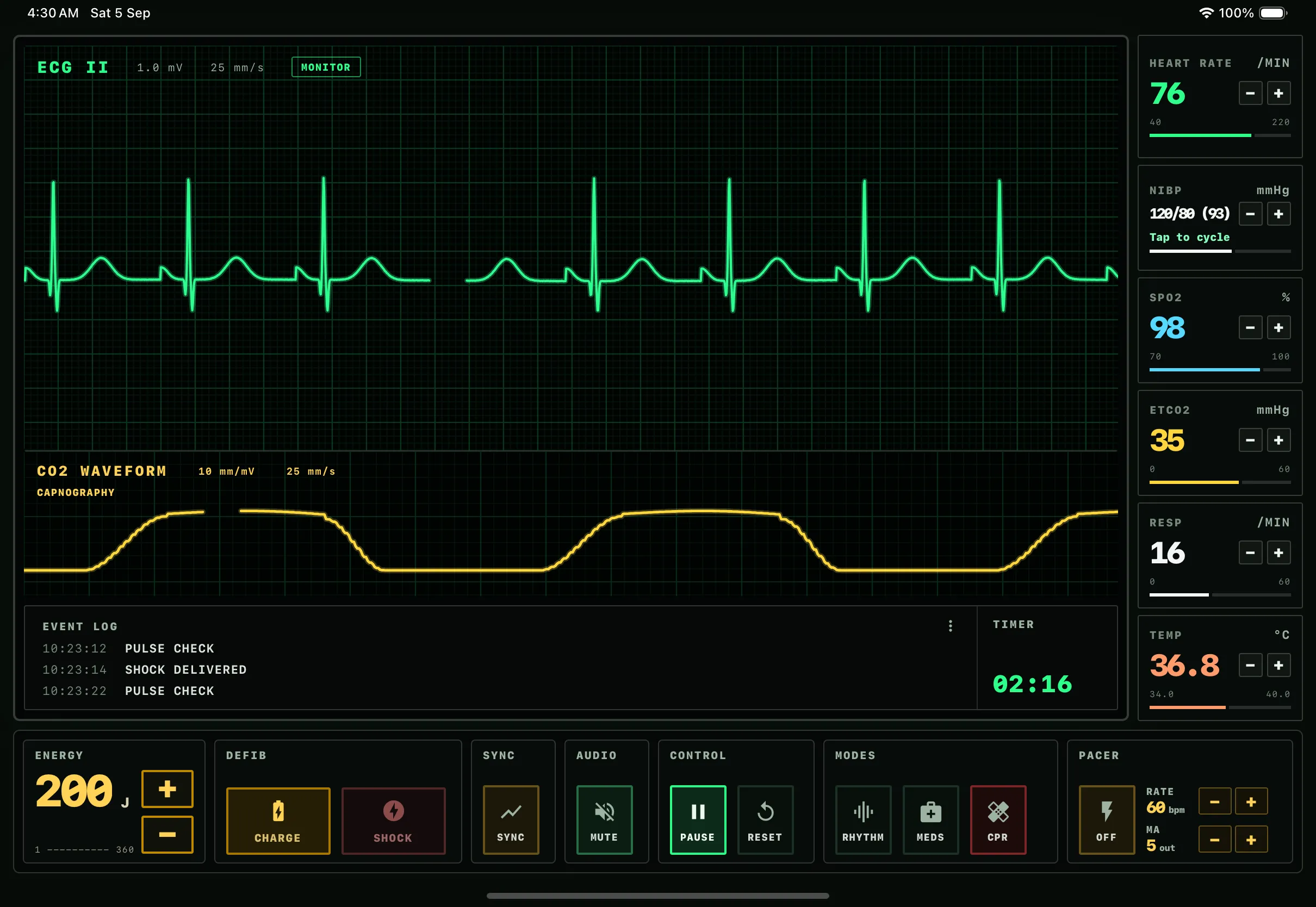
ECG, capnography and key observations remain visible beside the controls used during a teaching session.
Our product / Medical education
A training monitor built for decisions in the moment.
 TypeScript

 React Native & Expo
The challenge
Rhythm recognition and resuscitation practice are easier to teach when the monitor and controls stay in the same view. A static rhythm chart cannot show the pace of a session, while a fragmented interface makes it harder to change the scenario without interrupting it.
The system
We built a cross-platform monitor interface around selectable ECG rhythm strips, a generated capnography trace and adjustable vital signs. A shared sweep clock keeps the two traces visually aligned. Scenario presets provide starting rhythm and vital values, while the control dock keeps defibrillation, pacing, CPR, rhythm selection and medication entry close to the display.
Product capability
An educator can start from an ACLS, PALS or NRP preset, switch among 33 rhythm options, tune vital signs and operate the simulator controls without leaving the monitor. The display, controls, sounds and session timer provide a continuous setting for practice and discussion.
Inside the simulator
ECG and capnography traces, key observations and the control dock share one view, so the scenario never has to leave the monitor.
ACLS, PALS and NRP presets supply a starting rhythm and vital signs. From there the educator can switch among 33 rhythm options and tune the observations as the exercise continues.
Select an energy level, charge and deliver a simulated shock, toggle sync, set the pacer’s rate and output, run CPR and record a medication’s drug, dose and route, all from the same workspace.
ECG and capnography share one monitor clock and sweep position, so the two traces move in step. The ECG combines supplied rhythm strips with generated traces; capnography is generated.
SimRhythm is built with Expo, React Native and TypeScript, with Expo Router for navigation and React Native Skia drawing the monitor traces. One codebase runs on iOS and iPad, Android and the web.
ExpoReact NativeTypeScript iOS & iPad
 Android
ECG, capnography and key observations remain visible beside the controls used during a teaching session.
ACLS, PALS and NRP presets set an initial rhythm and vital signs; educators can adjust them as the exercise continues.
Charge and shock, sync, external pacing, CPR, rhythm selection and medication entry are available in the same simulator workspace.
The sector around it
Our line on AI here: AI should not set clinical values, rhythms or algorithm steps, and it should not decide whether a learner passes. Those stay with qualified educators.
Rules and standards in this sector ↗October 2025
Resuscitation Council UK published new guidelines, with updated courses from January 2026, so algorithms and scenarios need revisiting.
October 2024
The government began checking public sector websites and apps against WCAG 2.2 AA, which adds criteria on focus, dragging and target size.
September 2024
The one-year grace period ended, so Saudi training providers handling learner data now face enforcement by SDAIA.